

“Digital generation our generation”.
International day of the girl child is celebrated every year on 11th October with the aim of identifying the issues facing girls internationally and looking out for ways to address these challenges. Some of the issues which tend to be focussed on are; existing inequalities, child marriages, malnutrition and issues about gender based violence. It also aims at helping girls get education so they can be of more importance in the society, empowering girls and raising awareness on their rights and responsibilities as upcoming young women. Every year has its own theme and 2021 theme is “digital generation our generation”.
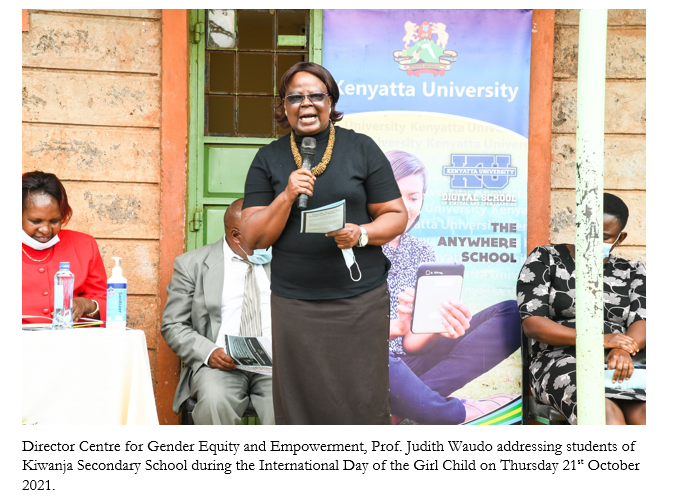
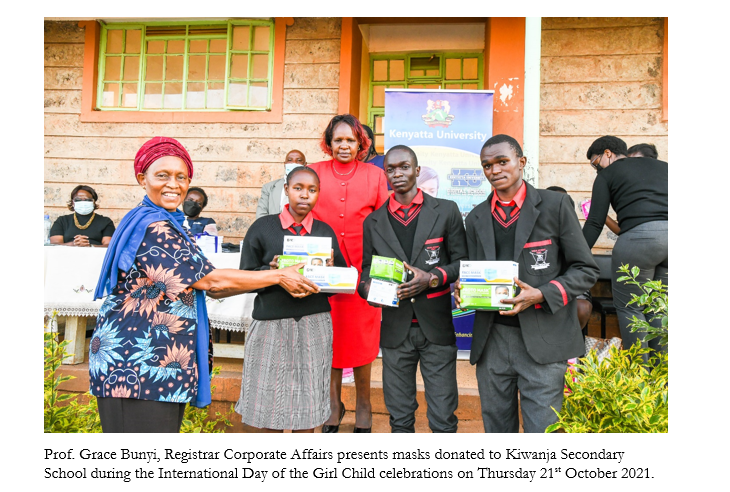
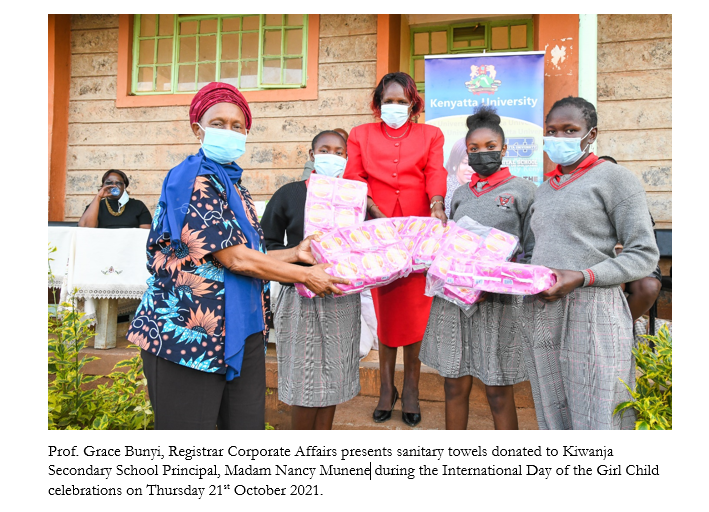
The centre for gender and Equity empowerment together with students from Kenyatta University science, technology, engineering and mathematics (STEM) club, KUGAM and members of staff went to Kiwanja Secondary School to celebrate the international day of the girl child on Thursday 21st October 2021.
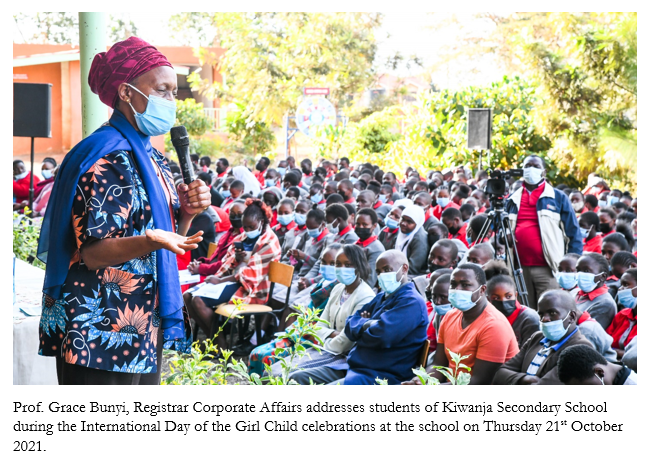
Represented by Prof. Grace Bunyi, Registrar Corporate Affairs, the Vice-Chancellor, Kenyatta University, Prof. Paul K. Wainaina in his speech noted that girls should have equal access to the internet and digital devices which are meant to meaningfully and safely grant them the opportunities to grow intellectually and financially. He emphasized that the challenges faced by girls in regards to schooling and technology affects not only their life chances and educational opportunities, but also limits career choices and reduces their employment chances. Bridging the gender gap in education and levering technology is important to urgently meet the educational needs of girls especially during the Covid-19 pandemic. In a generation and age where technology is rapidly growing and will continue to grow in future, we have an obligation to harness its power for good and make sure it is available and beneficial to and for all. To conclude, the Vice Chancellor underscored the importance of continuously inspiring all to bring about transformative change that will lead to elimination of gender discrimination, and empower girls for individual and societal growth and development.

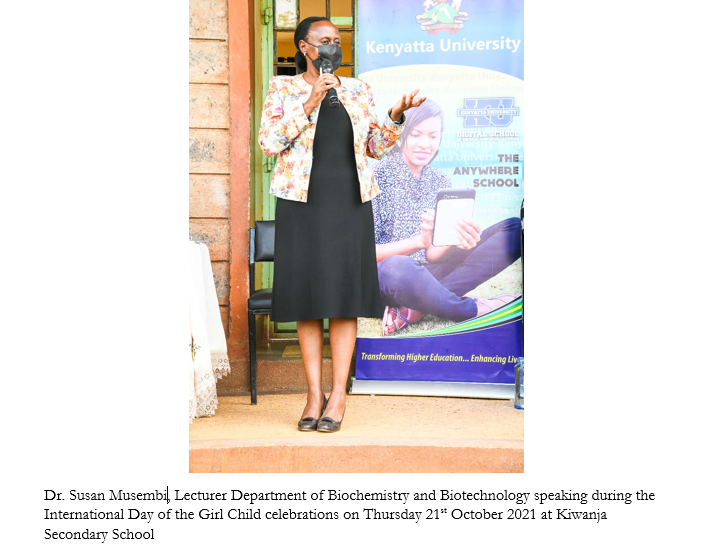
In her speech, Dr. Susan Musembi advised the students to know what degree they want to pursue in the university and the requirements needed to enter into the said programme. She further encouraged them to harness the knowledge they have acquired to practice entrepreneurship and innovation. They should have the ability to create jobs for themselves and others.
Prof. Ruth Wanjau stated that students need to actualize their dreams by doing them. They should ask themselves “do I know how to do it?” She said that one should have the skills and knowledge to be there. She further went ahead to advice that they need to be observers and learn from that. They should remain focused to achieve their dreams and the most efficient way to do it, is to just do it.
Allan Koech a student of BSc .Biomedical engineering, in his speech encouraged students to have curiosity and interest in knowing how things work and why they work. Always ask this two questions HOW? (How things work the way they do) and WHY (why do they work the way they do) and when you find yourself facing a problem ask yourself, “How can I solve this problem?” that could be the next big business
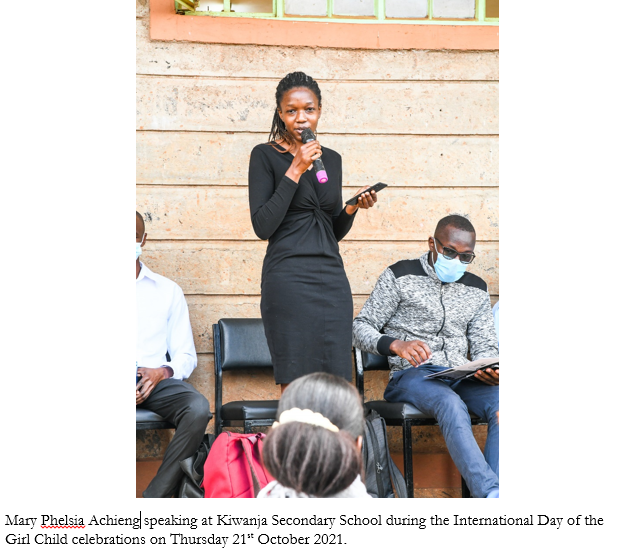
Mary Phelsia Achieng, a student of BSc. Information and technology, pointed out that science is not” a man thing” but a human thing. She went ahead and said that passion should guide one in choosing their career. Even though as women and more so girls, face so many challenges, like disparity in the tech ecosystem, gender profiling, misogyny and inequality when it comes to payment in the workforce, females are capable of doing so much more than what the world has set for them. Focus and determination can take you to unimaginable places.
Apart from the celebrations, the Centre donated sanitary towels, mask and books published by Prof. Judith Waudo, Director Centre for Gender Equity and Empowerment.
- Details
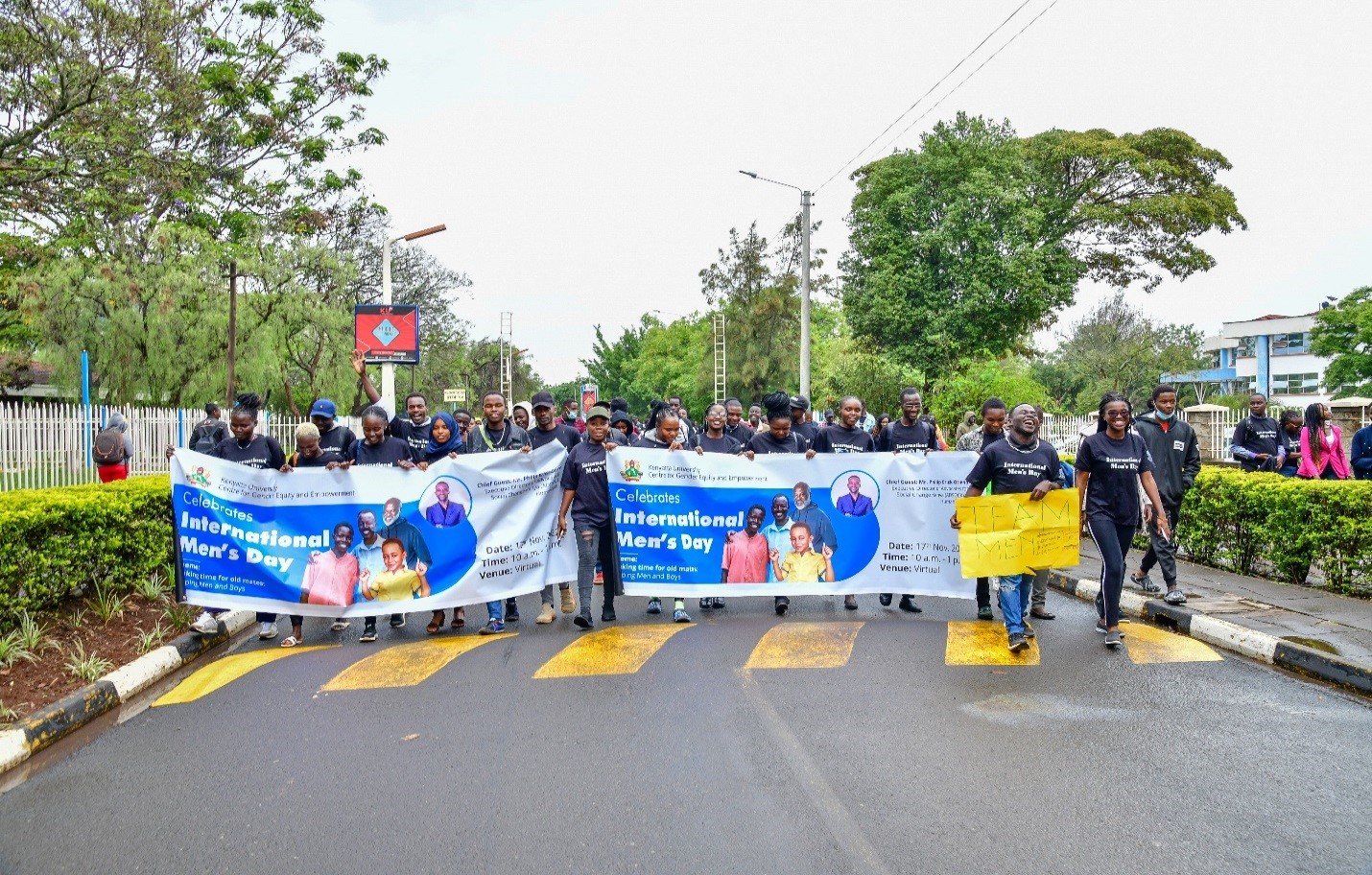
International Men's Day (IMD) Celebrations, 2022
Kenyatta University Centre for Gender Equity and Empowerment in collaboration with Kenyatta University Gender Action Movement (KUGAM) marked the International Men’s Day on 17th November, 2022 through a webinar. The International Men's Day (IMD) is an annual international event which focuses on men's and boys' health, improving gender relations, promoting gender equality, and highlighting positive male role models. It is an occasion to highlight discrimination against men and boys and to celebrate their achievements and contributions in the community, family, marriage, and child care. The broader and ultimate aim of the event is to promote basic humanitarian values.
At Kenyatta University, the day was commemorated under the theme “Making time for old mates: Helping men and boys”. The guest speaker to the event was Mr. Philip Otieno, Executive Director, Advocates for Social Change-Kenya (ADSOCK).
There was a commendable attendance from University Community led by the Vice Chancellor representative Prof. Paul Okemo, Ag. Deputy Vice Chancellor, Administration, staff members and students.
The official welcoming remarks were made by the Director, Centre for Gender Equity and Empowerment, Prof. Judith N. Waudo.
Other speakers were:
1) Mr. Kevin Karasi, Congressman School of Public Health, representing KUSA Chairman
2) Prof. Paul Okemo - Vice Chancellor representative
3) Mr. Philip Otieno - Chief Guest
From their speeches all speakers acknowledged the importance of friend, both old and new. They also encouraged men to not be afraid share their feelings and emotions for their well-being.
In his speech the Vice-Chancellor reminded men that it is their responsibility to create good relations, improve relations and maintain good relations. This can only be achieved by making time for friends and family, both the older and younger generations and should also teach our young sons and brothers, the importance of having good and productive friends in their lives. Prof. Okemo also called upon men to not only excel in academics but also embrace change and be mentors and role models to juniors. He commended the Centre for Gender Equity and Empowerment in its efforts in promoting gender equality and equity in all spheres of the university.
Mr. Philip Otieno, Executive Director, Advocates for Social Change-Kenya (ADSOCK) observed that close friendships and social connections can promote good health. Good friendships can help in dealing with mental health issues, male suicide rates, male survivors of sexual violence, male vulnerabilities, negative portrayal and blanket condemnation of men, male engagement in social justice initiatives among others.
He concluded by noting that most men hold multiple experiences of privilege and oppression. The challenge is to move towards accountability and consciousness where we have privilege, empowerment and healing where we are targeted and partnerships - overall work to build alliance with others toward the systemic change that will end the inequalities and exclusion.
Students on the walk around Kenyatta University, Main Campus during the International Men’s Day celebrations on 17th November 2022
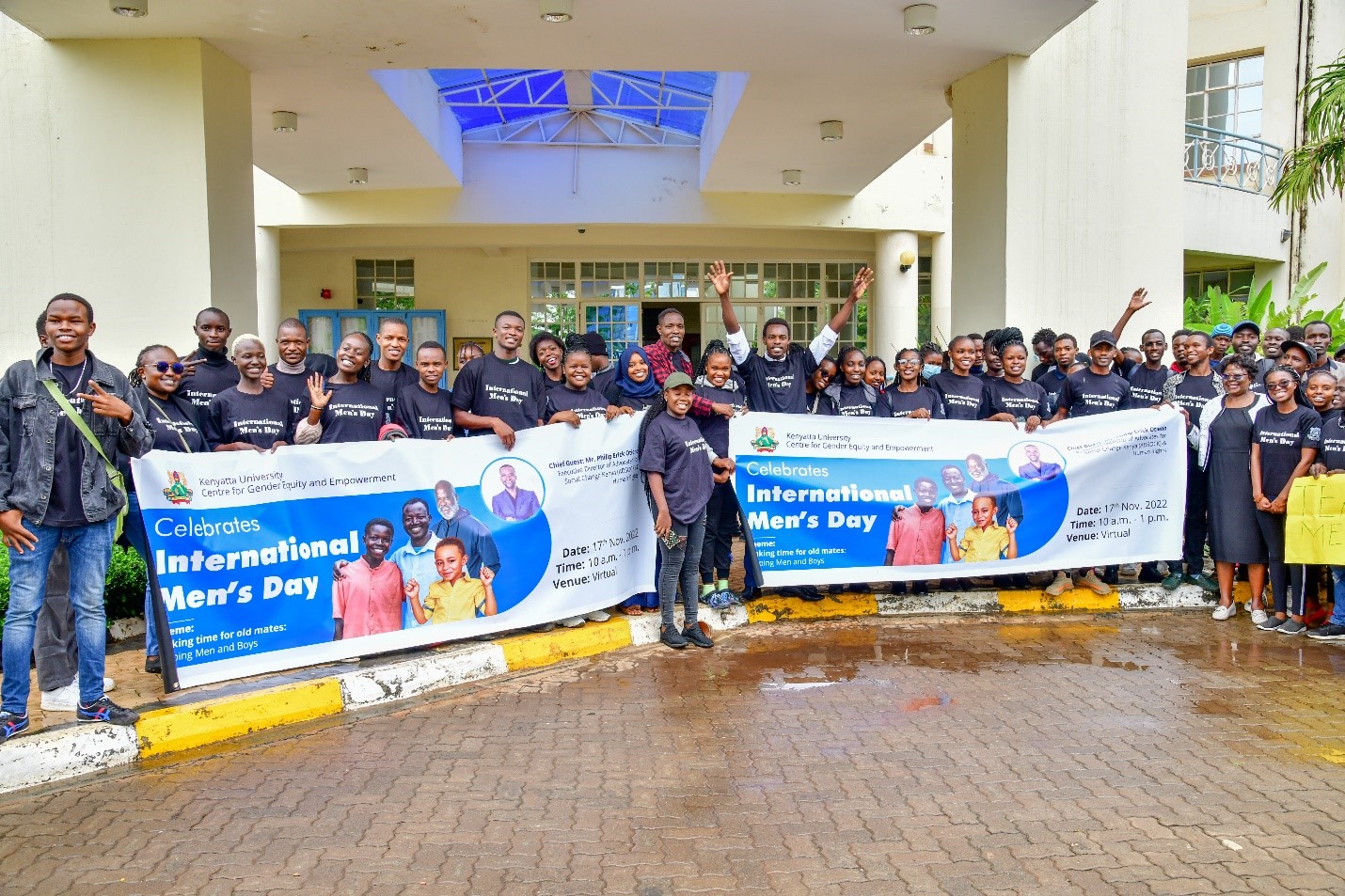
Students with Prof. Judith Waudo, Director, Centre for Gender Equity and Empowerment (far right) during the International Men’s Day celebrations on 17th November 2022
- Details
The Centre for Gender Equity and Empowerment in collaboration with Kenyatta University Gender Action Movement (KUGAM) organized to celebrate the 16 days of activism against gender based violence on Friday 25th November 2022 at BSSC room 14 from 10 am – 1pm.
This year’s theme was “UNITE! Activism to end violence against women and girls” and invites everyone to play their role in ending violence against women and girls, show support and solidarity to women’s rights activists.
1. Friday 25th November 2021 – Open discussion during the launch of 16 Gays of Activism against GBV at BSSC room 14
Prior to the talk, students went on a campaign walk, led by Dr. Okong’o, beginning at the KU main gate through the Shopping Centre, Bishop Square, Amphitheatre and ended at BSSC room 14. The walk was a peaceful protest against Sexual and Gender Based Violence at Kenyatta University.
The open discussion had five panelists namely;
1. Dr. Grace Okong’o - Department of Sociology, Gender and Development Studies
2. Mr. Richard Muchiri Njenga – Department of Sociology, Gender and Development Studies
3. Miss. Joan Wanjiru Gicu - Department of Sociology, Gender and Development Studies
4. Miss. Fancy Chepkoech – School of Public Health
5. Mr. Farren Kuindwa – Department of Early Childhood Education and Special Needs
Contextualizing GBV in Universities
Gender based violence is entrenched in the strong patriarchal ideologies of control and subordination of women and girls. Efforts to resists this has mostly been undertaken at individual level. As a result, GBV continues to thrive even in higher learning institutions. In universities, GBV can happen in the following context;
- Staff to student
- Student to staff
- Student to student
- Staff to staff
Dr. Okong’o noted that, GBV, whether physical or emotional, is all about POWER and CONTROL. In most cases, perpetrators have someone of influence and supremacy which they use to either manipulate or overpower their victims or survivors.
This power and control can be in terms of money, position of power (leader/boss), physical strength or gender power (either man or woman).
Perpetrators often use this power to threaten and silence their victims either through bribery or coercion and stops the survivors from reporting or pursuing the case against the offender. This gives more power to the offender and he/she keeps doing it to other people.
Further, it was noted that, acceptance of violence is very easy because most of the survivors do not know how to react to it. This is because most have accepted it as a way of conflict resolution as violence begins from families and society.
Prevention and Response to GBV
It was noted that; the prevention and response to GBV mechanisms are in place only that they do not work properly even at the national level. The systems need to be reformed and strengthened to operate better in prevention of and response to Gender Based Violence.
At Kenyatta University, the Vice Chancellor appointed a standing committee to be investigating Sexual Harassment (SH) and Sexual and Gender Based Violence (SGBV) cases. The committee comprises of staff from various critical sections that deals with students and staff with the following Terms of Reference:
a) Receive and investigate all cases of Sexual Harassment (SH) and Gender Based Violence (SGBV).
b) Ensure that all complains of SH and SGBV are investigated thoroughly and expeditiously.
c) Ensure that proper documentation of evidence is provided during investigations.
d) Evaluate the evidences and recommend appropriate actions to the Vice-Chancellor.
Way forward
Dr. Okong’o urged the participants to empower themselves with information and learn self-advocacy. In this way they will know;
a. What to do to avoid being a possible target
b. What to do in case one is attacked
c. What to do in cased one is harassed, assaulted or raped
d. Where to seek help (hospital, security, counseling)
Opportunities for joint advocacy can be done through the media, by strengthening the gender sector working groups, engaging men and boys in the fight against SGBV, engaging with GBV actors locally, nationally and internationally, supporting evidence based research on GBV to help influence policies and capacity building for the police on gender issues and equipping them with gender desks.
The Centre for Gender Equity and Empowerment will continue to advocate for gender mainstreaming through continued training and educating the University community (students and staff) on gender issues, prevention of and response to Sexual and Gender Based Violence (SGBV).
The session concluded that activism against GBV should be a year round effort but not only celebrated during the 16 days of activism against GBV.
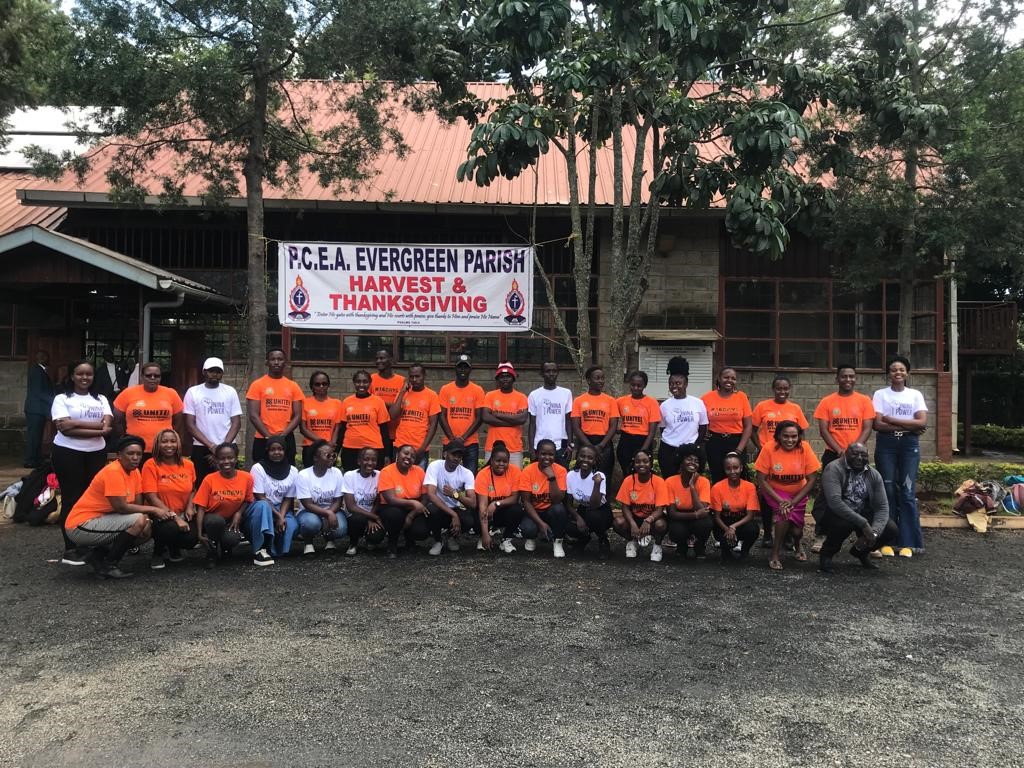
2.Sunday 4th December 2022 – Outreach campaign at Presbyterian Church of East Africa (PCEA) Evergreen, Runda
As part of community outreach to campaign against gender based violence, Prof. Wamue Ngare led a team of 31 students and 5 members of staff to worship at the Presbyterian Church of East Africa (PCEA) Evergreen, Runda. She spoke to the youth. The service was from 9am – 12 noon.
During her talk at the church, Prof. Wamue-Ngare encouraged the young people to speak up against GBV, as a survivor or a witness. She emphasized that waiting is always fatal (death) and so is ignorance. Some of the most common manifestations of GBV are; physical beating, rape, verbal, mental and emotional abuse.
Therefore, it is important that people empower themselves with knowledge and economically to avoid relying on persons who will take advantage of them.
Further, she also informed the congregation the impacts of SGBV on the victims and survivors; death, depression, anxiety, substance abuse, self-harm and Post-Traumatic Stress Disorder (PTSD).
Prof. Wamue-Ngare advised on what they should do collectively and as individuals in order to fight against gender based violence through; breaking the culture of silence and learn that NO is NO.
Students accompanied Prof. Wamue-Ngare (far left) for Outreach campaign at Presbyterian Church of East Africa (PCEA) Evergreen, Runda on Sunday 4th December 2022
3. Panelists spoke about Gender Based Violence on KUTV
To spread the message about Gender Based Violence, three speakers were sourced and appeared on KUTV morning show on 5th, 6th and 7th December 2022.
i. On 5th December 2022, Dr. Boniface Munene Rufo, Ass. Lecturer, Chuka University, Dept. of Social Sciences spoke about GBV from a male perspective.
ii. On 6th December 2022, Dr. Willy Mwangi, lecturer, Kenyatta University, Dept. of Sociology, Gender and Development Studies spoke about GBV in the work place.
iii. On 7th December 2022, Mr. Wesley Onyango, Chairperson, Kenyatta University Gender Action Movement (KUGAM) spoke about GBV among the youth.
In all there talks, they all agreed that, GBV begins from the core of the society, FAMILY. This creates a weak link in relationships and at the work place. Therefore, it is paramount to work on having stable homes/families first.
It was also noted that, it is of importance to include men in the talk of ending GBV. Men should be champions of GBV. They should be empowered with information about the dangers of GBV and its effects on their families and society. Additionally, men should be encouraged to speak up when GBV is perpetrated towards them. Men should be agents of change to end GBV.
- Details